
Meal planning sounds like a good idea until you actually sit down to do it.
You open a notebook or an app with the intention of making the week easier, and before you know it you’re trying to decide breakfasts, lunches, dinners, snacks, maybe even a few “healthy options” just in case. It feels productive in the moment, but it’s also exhausting. And when the week starts, the plan often falls apart faster than you expected.
If that happens to you, the problem isn’t that you’re bad at meal planning. It’s that you’re giving every meal the same weight, even though they don’t all create the same kind of stress.
Once you stop doing that, meal planning becomes much simpler.
How to decide what to plan by looking at your week
The most practical way to decide which meals to plan is to start with your calendar, not with food ideas.
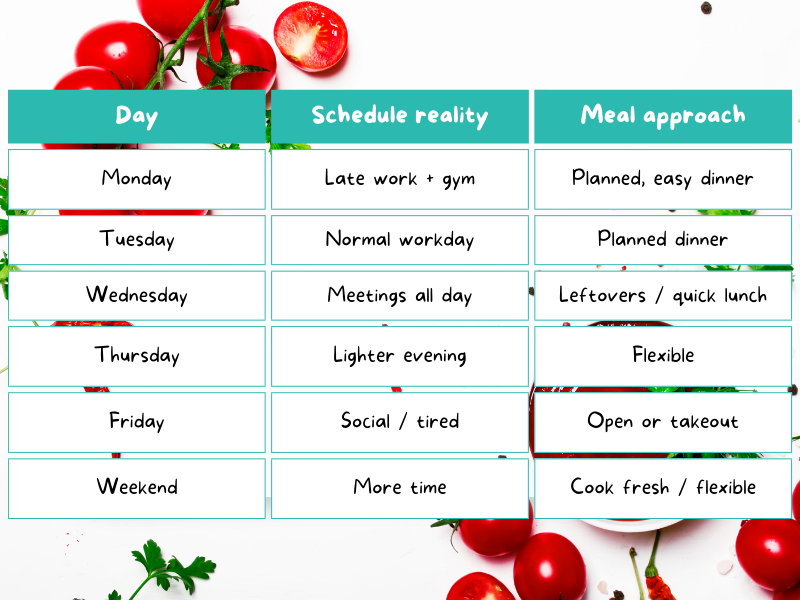
On Sunday, before you think about recipes or grocery lists, look at how your week actually looks. Not the ideal version of it, but the real one. Check your workdays, late meetings, gym sessions, errands, social plans, and anything else that affects your energy in the evening or your time during the day.
Then think about meals in relation to that schedule.
If you see evenings where you’ll get home late, those are not good nights for improvising. They’re the nights where you want dinner to be decided in advance. That doesn’t mean cooking something complicated. It just means knowing what’s available so you don’t have to think when you’re tired.
If you see a day packed with meetings or a long work-from-home stretch, that’s often a sign lunch needs some light planning too. Not a full meal plan, just the reassurance that something quick is already there. A wrap you can assemble in five minutes. Yogurt with fruit. Leftovers you already know are waiting in the fridge.
On lighter days, you can afford to stay flexible. When your schedule has space, your meals can have space too.
This is also where it helps to be clear about what “easy” actually means. Planning around a busy week doesn’t mean defaulting to canned meals or frozen food every day just because they’re convenient. Those can help occasionally, but they’re not meant to become the foundation of how you eat.
Instead, think in terms of food that’s already close to ready, not food that’s heavily processed. Fresh vegetables that are washed or peeled ahead of time. Protein cooked once and used more than once. Simple bases like rice, potatoes, or pasta made in advance so they’re there when you need them.
Planning doesn’t always mean cooking more. Very often it means making sure the fridge contains things that can be eaten quickly or put together without effort, while still being real food. Eggs, wraps, yogurt, cheese, vegetables, and leftovers tend to work better long-term than relying on packaged meals when you’re tired.
Leftovers play a big role here. When you plan dinners, it’s worth thinking one step ahead and asking which meals could also become lunch the next day. That single decision can remove a lot of weekday stress without adding any extra cooking.
The goal isn’t to match meals perfectly to your calendar. It’s to make sure that on busy days, something easy and nourishing is already available. On calm days, you don’t need to decide as much in advance.
If you finish your Sunday planning knowing that your busiest days are covered, you’ve done enough. The rest can stay simple.
Dinners are usually worth planning first
For most people, weekday dinners are the hardest part of the day food-wise.
They happen after work, when decision fatigue is already high. They’re time-sensitive. They often involve more than one person. And they tend to affect the rest of the evening. When dinner is late or stressful, everything after it feels off.
That’s why dinners are the place where planning gives you the biggest return.
When you know ahead of time what you’re cooking on a few specific evenings, you remove the most stressful daily decision from your week. You don’t stand in front of the fridge trying to invent something. You don’t negotiate with yourself or anyone else. You just start.
This is why many people feel relief as soon as dinners are planned, even if nothing else is.
Lunch doesn’t always need planning – until it does
Lunch is different.
In many weeks, lunch is a low-friction meal. You already have a rhythm. You eat leftovers, make something quick, or rotate through a few familiar options. It’s not perfect, but it doesn’t cause stress. You don’t dread it. You don’t waste much time thinking about it.
In those weeks, planning lunch in detail won’t make your life easier. It will just give you more decisions to manage.
But there are weeks when lunch quietly turns into a problem.
You notice you’re opening the fridge at 10 a.m. wondering what you’ll eat. You don’t have leftovers. You end up skipping lunch or grazing. You buy food every day and feel mildly annoyed about it. Or you work away from home more than usual and suddenly lunch requires more thought.
That’s when lunch becomes worth planning.
The key is that lunch earns a place in your plan only when it starts creating friction. Not before.
And even then, planning lunch doesn’t mean designing a full menu. It usually works best when you keep it loose. You decide on a few reliable options for the week, maybe plan which days will rely on leftovers, and leave the rest flexible. You’re not locking yourself into exact meals. You’re just removing the uncertainty.
When lunch goes back to being easy, you can stop planning it again.
Some meals are better left open
One of the biggest mistakes in meal planning is trying to decide everything in advance.
Real weeks don’t work like that. Energy changes. Plans shift. Leftovers appear. Sometimes you genuinely don’t feel like eating what you planned three days ago.
That’s why a good plan includes space.
Leaving one or two meals intentionally open gives your week somewhere to breathe. Those meals absorb leftovers, social plans, low-energy days, or the occasional takeout without turning it into a failure.
Flexibility isn’t the opposite of planning. It’s part of it.
Final thoughts
Start where it matters most. If you’re not sure where to begin, start small.
Pick the one meal that regularly causes stress in your week. For most people, that’s dinner. Plan that first and see how the week feels. You can always add lunch later if it becomes necessary.
Meal planning doesn’t need to cover everything to be useful. It just needs to remove pressure where pressure actually exists.
Once you plan the right meals, and stop planning the ones that don’t need it, the whole system becomes lighter, calmer, and much easier to stick to.